by : Arvin Paolo Diaz

Tuesday, August 12, 2014

Multiplying a Matrix to another Matrix


when multiplying two matrices, two sizes must be m x n and n x p and the resulting size is m x p.
2 x 3 ( m x n) and 3 x 2 ( n x p ) results to a 2 x 2 ( m x p) matrix.
you just multiply the 1st row to its corresponding column member and get the sum. then you get your first entry which in this case is 58.
 
(1 2 3) x (7 9 11) = (1 x 7) + (2 x 9) + (3 x 11) = 58

then just do the same thing again but do it with the first row then the second column.
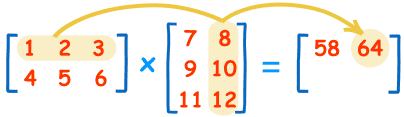
Matrix Multiply

(1 2 3) x (8 10 12) = (1 x 8) + (2 x 10) + (3 x 12) = 64

then just repeat it with the second row and 1st column then second row and 2nd column and you get the final matrix:

Matrix Multiply

FIN!


Sunday, August 10, 2014

Scalar Multiplication ...

Scalar Multiplication states that:

If matrix A = [aij] and c is a scalar, then cA = [caij].

you can use a combination of addition and scalar. for example
 solving a matrix m x n  A-B.

 A-B is just the same as A+(-B). you just do this by multiplying -1 to matrix B.

you can just do this if both matrix is the size m x n

Saturday, August 9, 2014

Operations with Matrices

Definition of Equality of matrices:
Two matrices are said to be equal if they have the same size m x n .

Matrix Addition:
If A= [aij] and B= [bij] are matrices of the size m x n then

A+B= [aij + bij]

The sum of matrices with two different sizes are considered undefined.


Friday, August 8, 2014

Polynomial Curve Fitting....

Polynomial Curve fitting is a procedure that is done to know one polynomial function p(x) passes through given points.

If you have a collection of data represented by n point on an xy-plane.

(X1, Y1) (X2, Y2) ... (Xn, Yn)

then the polynomial function will have a degree of n-1 with the resulting p(x):

 p(x) = a0 + a1x + a2x2 + . . .  + an-1xn-1

To solve the n coeffiecients of p(x), substitute each of the n points into the polynomial function and obtain n linear equations in n  variables.

Thursday, August 7, 2014

Network Analysis....

Network analysis are made up of one or more Junctions that are inter-connected in some way.It states that the amount that flows in is equal to the amount that flows out. These networks can be represented into a system of linear equations.

this is an example of a network with one junction. it can be expressed into the equation X1 + X2 = 25
(note the direction of the arrows).

These networks can be used into representing traffic problems, economic problems and with Kirchhoff's Law

Kirchhoff's Law is used when representing Circuits by the use of networks. It states that:

1.The sum of the current that goes in a junction is equal to the amount of current that comes out of it.

2.In a Closed path,the sum of the product of the resistance (ohms) and Current (Amperes) is equal to total voltage (Volts) of the path .

* the direction of the circuit sometimes depend on the battery symbol. the longer side is the output and the shorter side is the input.


example of a network of circuits that applies to Kirchhoff's Law. (note the direction of the circuit).


Saturday, June 28, 2014

Row-Echelon in matrices


a matrix is said to be in row echelon form if:


  a.) all of the leading coefficients is 1.
  b.) each of the succeeding row from the bottom has the leading coefficient of 1
  c.) if the bottom row has all zeros (consistent dependent system).


an example of a matrix in row-echelon form.


a matrix is said to be in reduced row-echelon form if:
 a.) it is in row-echelon form.
 b.) every leading coefficient is 1 and is the only non zero entry. (besides the constant).


an example of a matrix in reduced  row-echelon form.


Gaussian Elimination...

-also known as Row Reduction 

-an algorithm for solving systems of linear equations. It is usually understood as a sequence of operations performed on the associated matrix of coefficients. This method can also be used to find the rank of a matrix, to calculate the determinant of a matrix, and to calculate the inverse of an invertible square matrix. The method is named after Carl Friedrich Gauss, although it was known to Chinese mathematicians as early as 179 AD.


                            Here is an example of a augmented matrix to a row-echelon form.

\left[\begin{array}{rrr|r}
1 & 3 & 1 & 9 \\
1 & 1 & -1 & 1 \\
3 & 11 & 5 & 35
\end{array}\right]\to
\left[\begin{array}{rrr|r}
1 & 3 & 1 & 9 \\
0 & -2 & -2 & -8 \\
0 & 2 & 2 & 8
\end{array}\right]\to
\left[\begin{array}{rrr|r}
1 & 3 & 1 & 9 \\
0 & -2 & -2 & -8 \\
0 & 0 & 0 & 0
\end{array}\right]\to
\left[\begin{array}{rrr|r}
1 & 0 & -2 & -3 \\
0 & 1 & 1 & 4 \\
0 & 0 & 0 & 0
\end{array}\right]